Most Nigerians building a house lose money as a result of poor supervision. Here's exactly what construction project management services in Nigeria cover, what they cost in 2026, and how to choose the right one.
Construction project management services in Nigeria typically cost between 3% and 10% of your total project cost, depending on scope, and they cover everything from budgeting and contractor selection to site supervision and fraud prevention. If you’re building from Lagos, Abuja, or London, this guide walks you through exactly what these services do, what they cost, and how to pick the right one.
Construction project management services in Nigeria are professional services that plan, coordinate, budget, schedule, and supervise a building project from start to finish. A construction project manager handles contractor selection, cost control, quality checks, and risk management so the client doesn’t have to be on-site every day or in the country at all.
It’s essentially having someone in your corner whose only job is to make sure your money becomes a building, not a story you tell at family gatherings about “that contractor wahala.”
Building costs keep climbing. Cement, blocks, iron rods prices move faster than most people can budget for. And with more Nigerians in the diaspora sending money home to build, the gap between “person paying” and “person supervising” has never been wider.
That gap is exactly where fraud thrives. A supervisor visiting once a week can’t catch a contractor who orders cement for one room and uses it across two. A busy professional who trusts “my brother will check on it” is often the same person calling six months later asking why the roof still isn’t on.
Construction project management services in Nigeria exist to close that gap. Not with promises but with structure and control.
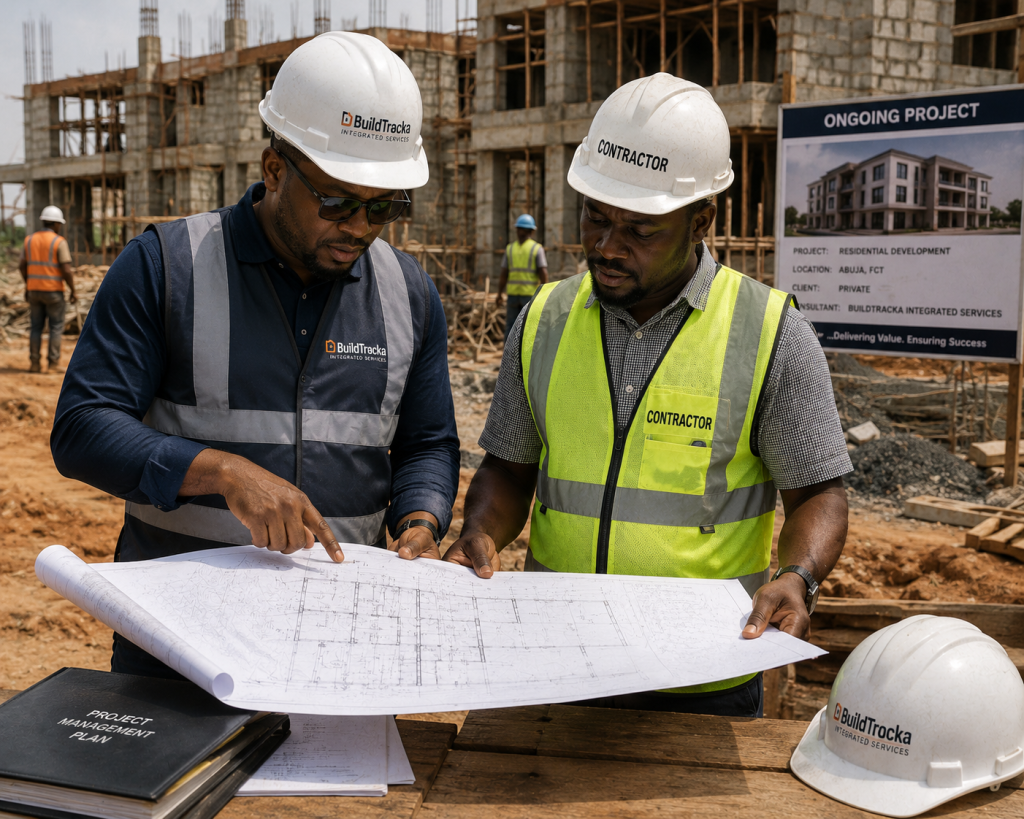
A proper construction project management firm doesn’t just visit or check on the site. The scope is broader, and it usually includes:
This is the part most people never see explained clearly, so here’s the step-by-step guide to construction project management in Nigeria, from the first meeting to handover.
Before anything else, a good project manager sits with you to understand the budget, the site, and what you actually want. This step alone reduces a huge chunk of the ” we ran out of money” stories you hear.
Your architect draws the vision. Your structural engineer confirms it will stand. The project manager makes sure both are working from the same page and that the design is actually buildable within your budget.
Instead of hiring the contractor yourself, a project manager runs a proper tender, multiple quotes, background checks, and a contract that protects you, not just the builder.
A realistic timeline gets built, one that accounts for Nigerian realities like rainy season delays and material price swings, not just an optimistic best-case scenario.
This is the daily or weekly work which includes inspections, material verification, workmanship checks etc. It’s the reason a project manager catches a substandard foundation before the third floor goes up, not after.
Payments get tied to verified milestones, not hearsays. Material orders get cross-checked against what’s actually delivered and used. This single step is where most Nigerians building remotely lose the most money and where good project management earns back its fee many times over.
You get updates including photos, videos, written reports every day. This way, you’re directly involved in your construction process not just hoping that things are being done well.
A final walk-through, a snag list of anything that needs fixing, and full documentation and certification that everything is okay before you accept the keys.
Here’s the part everyone actually wants to know. Fee structures vary, but most firms in Nigeria charge one of three ways:
| Fee Model | How It Works | Typical Range |
|---|---|---|
| Percentage-based | A percentage of total construction cost | 3% – 10% |
| Fixed monthly fee | A flat retainer, common on smaller or shorter projects | Agreed upfront, varies by scope |
| Hybrid | A lower percentage plus a fixed monthly component | Negotiated per project |
The exact percentage depends on project size, complexity, and how hands-on the supervision needs to be. For the full cost breakdown of what building itself costs not just management, our guide on bungalow vs. duplex construction costs in Nigeria covers that in detail, and you can also see how these fees compare against architect fees in Nigeria, since the two are often confused.
| Project Type | Typical Timeline |
|---|---|
| Residential house | 6 – 12 months |
| Mid-rise apartments | 12 – 24 months |
| Commercial building | 18 – 36 months |
A good project manager doesn’t promise you a shorter timeline just to win the job. They give you a realistic one and then work to protect it from the delays that usually blow past it like late material deliveries, contractor disputes, and design changes mid-build.
People mix these up constantly, so here’s the quick answer:
Think of it this way: the project manager is steering the ship, and the site manager is making sure the engine room runs properly. On smaller projects, one experienced professional sometimes does both. On larger ones, you need both roles working together.
No, and this is one of the biggest misconceptions out there. It’s genuinely useful for:
If anything, the smaller and more remote your involvement, the more you need it because there’s less room to absorb a costly mistake.
Yes, and this deserves its own answer because it’s the question we get asked most. Structured project management reduces fraud risk through:
None of this makes fraud impossible. But it makes it a lot harder to pull off quietly and that’s usually enough to stop it before it starts. For a more detailed analysis read our Complete Guide on How to Avoid Contractor Fraud in Nigeria (2026)
Before you hire anyone, run through this checklist:
This last point matters more than people realize. A project manager who works independently of the building contractor has every incentive to protect your interest, not the contractor’s margin. That’s the model we work from at Buildtracka, supervising and managing builds on behalf of the client, including diaspora Nigerians who can’t be on-site, without a financial stake in the contractor’s costs.
If you’re weighing whether to manage the process yourself, our guide on how to build a house step by step in Nigeria is a good place to see exactly what you’d be taking on solo.
A checklist of qualities is useful, but it helps to know what independent oversight actually looks like in practice, day to day, on a real site.
According to Abdulsamad Ajetunmobi, founder of Cityscape Projects and Engineering, a Remote Construction Assurance firm operating in Nigeria, real oversight isn’t a single inspection at handover. It’s a standing practice, built around a few non-negotiables:
As Ajetunmobi puts it, payment protection and quality assurance need to be treated as two separate concepts. A client can have airtight escrow and still discover, eighteen months in, that the foundation was poured with the wrong mix because nobody who understood concrete was ever standing on the site to check. By then, fixing it often means tearing down work that’s already been paid for.
If you’d rather see real options than just a checklist, here are firms active in the Nigerian residential construction management space worth researching further. Always verify current portfolio, licensing, and references directly before hiring. This list is a starting point, not an endorsement.
| Company | Focus | Notes |
|---|---|---|
| The Building Practice Ltd | Bespoke homes, luxury estates, apartment complexes | Offers full project and construction management |
| TAD Builders Limited | Premium residential construction, real estate development | Lagos-based; also handles facility management post-build |
| JECCL (Jedha Engineering and Construction Company Limited) | High-end residential homes and apartments | Known for end-to-end residential delivery |
| Elalan Construction Company Limited | Residential estates and large-scale housing developments | Long-standing track record on large residential projects |
| Cappa D’Alberto Limited | High-end bespoke homes | Strong emphasis on finishes and design integrity |
| Jetich Project Limited | Precision-built custom homes and estates | Structured project management focus |
If your project is more on the pure oversight side involving independent supervision without also being the contractor, that’s where firms like Buildtracka sit managing the process on your behalf rather than building and managing at the same time.
They cover planning, budgeting, scheduling, contractor supervision, quality control, and risk management for a building project, from the first drawing to final handover.
When your project is complex, involves multiple contractors, has a significant budget, or when you simply don’t have the time or expertise to supervise the site yourself especially if you’re building from abroad.
The project manager oversees planning, budget, contracts, and client coordination. The site manager handles daily on-site supervision and execution.
Yes. Tendering, milestone-based payments, and independent inspections are specifically designed to catch and prevent it.
A project brief, scope of work, tender documents, contracts, schedules, cost estimates, progress reports, a risk register, and handover documentation.
Yes. Coordination with architects, structural engineers, and quantity surveyors is part of the job, not an optional extra.
Absolutely, the same cost control and contractor coordination benefits apply, just at a smaller scale.
Building in Nigeria doesn’t have to end with a bitter story all the time. The difference between a smooth build and a painful one usually isn’t the money you have but the structure around how that money gets spent.
If you’re planning a build and want someone independent watching over the budget, the contractor, and the timeline on your behalf, Buildtracka Integrated Services offers construction project management and site supervision for clients across Nigeria and the diaspora. Reach out for a consultation before you break ground, not after something’s already gone wrong.
Related reading: