Aluminium, stone-coated, or zinc? Here's what actually holds up on Nigerian roofs in 2026 broken down by climate, budget, and real market prices, not brand hype.
The best roofing sheets in Nigeria in 2026 isn’t a single product. They depend on where your house sits, how much sun and rain it takes, and what you’re realistically budgeting per square metre. A sheet that performs beautifully in dry Kaduna heat can behave very differently on a salt-air coastline in Port Harcourt. This guide breaks it down by climate and by budget, with current 2026 market prices, so you’re choosing with facts instead of guessing along with your contractor.
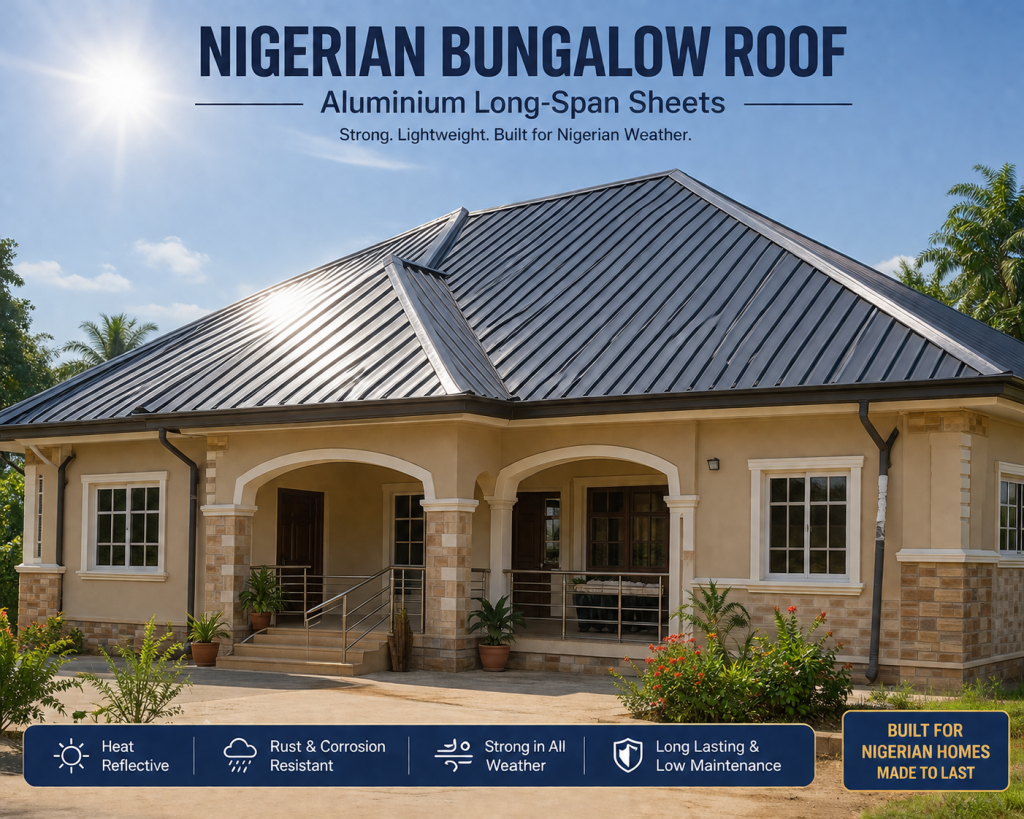
If you want the short version before you dive in:
Now, let’s go section by section so you actually understand why, not just what.
Here’s the thing nobody tells first-time builders but i will tell you. Your roof isn’t just the cap on your house. It’s the single material most exposed to Nigeria’s weather extremes, every single day, for decades, and it’s the hardest part of the building to fix once it’s up.
Get it wrong, and you’re not just repainting a wall. You’re re-scaffolding, stripping sheets, replacing timber that’s now water-damaged, and possibly dealing with mould inside your ceiling. That’s not a small mistake, that’s a five-to-seven figure naira mistake, depending on how far the water travelled before anyone noticed.
Get it right, and your roof quietly does its job for 30 to 50 years while you worry about literally everything else involved in owning a house.
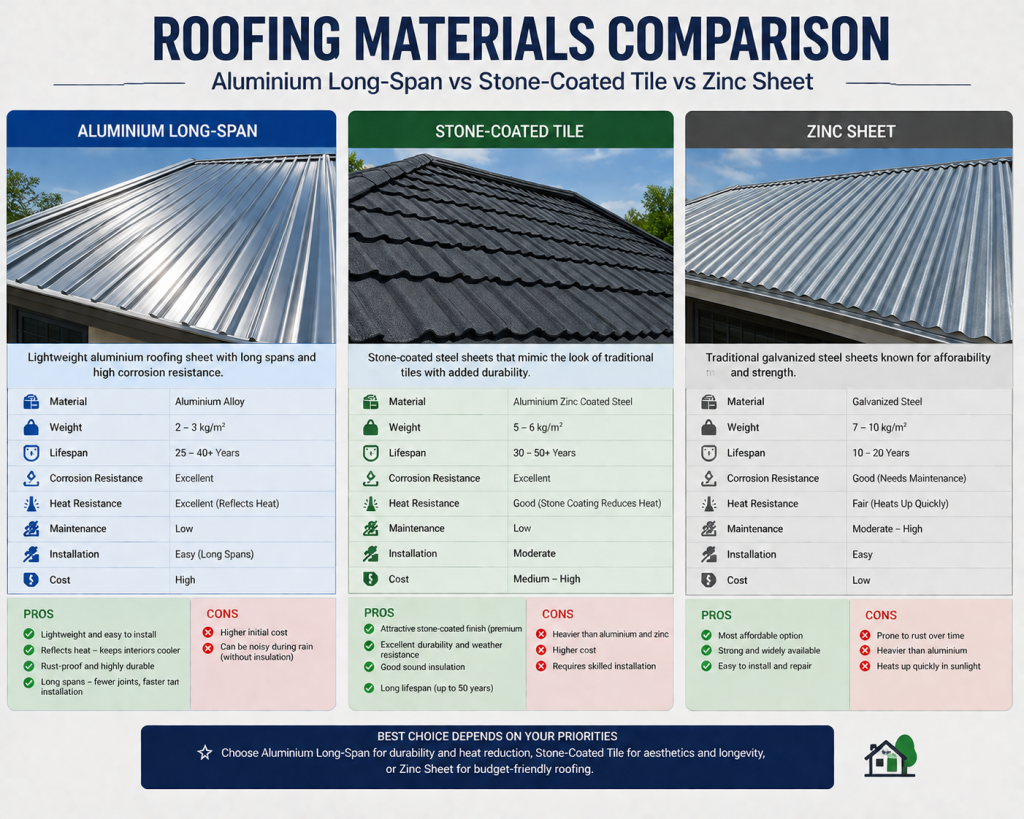
Before climate and budget, you need to know what’s actually on the market. Here’s the honest rundown:
Long-span aluminium sheets. The most common roofing sheet in Nigeria today. Lightweight, doesn’t rust like zinc, comes in long continuous sheets that reduce the number of joints (and joints are where leaks start). Sold in gauges from 0.40mm up to 1mm.
Step-tile and Metcopo aluminium. Same aluminium base as long-span, but pressed into a tile-shaped profile so it looks like a tiled roof from the ground. Slightly pricier than plain long-span because of the extra pressing process.
Stone-coated steel tiles (Gerard-type). Steel sheets coated with natural stone chippings, usually imported (New Zealand and Korean brands dominate this segment). Heavier, quieter in the rain, and genuinely handsome, this is what most premium Nigerian duplexes you admire on Instagram are roofed with.
Zinc / Aluzinc corrugated sheets. The classic, cheapest option. Still widely used for boys’ quarters, fences, and budget builds, but thinner gauges corrode faster, especially near water or in high-humidity zones.
Fibre-cement and bitumen (Onduline-type) sheets. Less common for main residential roofs, more popular for warehouses, garages, and some low-cost housing schemes.
This is the part most top 10 roofing sheets articles skip, and it’s honestly the part that matters most. Nigeria isn’t one climate. Kano and Calabar are not roofing the same way, and pretending otherwise is how people end up with rust three rainy seasons in.
In these zones, your roofing sheet spends most of the year absorbing brutal sun. Heat transfer into the ceiling is the real enemy here, not corrosion.
What works: Long-span aluminium sheets in lighter colours (white, silver, beige) reflect more heat than dark colours. Aluminium is also naturally lighter than steel, which matters for roof structure cost. Pair with ceiling insulation (foil or PU board) if you want the house genuinely cool without running the AC all day.
Price range: ₦5,300–₦8,600 per sqm for standard 0.45mm–0.55mm gauges.
These areas get sustained, heavy rainfall for months, and the sound of rain on a thin sheet at 2am is a very real reason people upgrade.
What works: Thicker-gauge aluminium (0.55mm and above) with proper overlap and pitch, or stone-coated tiles, which noticeably reduce rain noise and handle water run-off better because of their tile profile and deeper corrugation. Whatever you pick, pitch and gutter design matter as much as the sheet itself, a good sheet on a badly pitched roof will still leak. Preferably, a pitch of an angle not less than 25 degrees works best except you’re working with an hidden roof.
Price range: ₦5,700–₦12,000 per sqm depending on gauge and whether you go aluminium or stone-coated.
Salt in the air accelerates corrosion on anything metallic, and this is where a lot of people cut corners and pay for it within five years.
What works: Stone-coated steel tiles with proper anti-corrosion coating, or marine-grade aluminium sheets specifically rated for coastal use. Avoid thin zinc entirely here, it’s the fastest thing on this list to start showing rust streaks in salty coastal air.
Price range: ₦6,500–₦12,000 per sqm for coastal-appropriate materials.
Here’s a snapshot of current 2026 market rates. These are material prices per square metre inluding labour, timber, and accessories (ridges, gutters, nails) are separate, and we’ll cover that next.
| Roofing Sheet Type | Typical Gauge | 2026 Price Range (₦/sqm) | Best For |
|---|---|---|---|
| Long-span aluminium (light gauge) | 0.45mm–0.55mm | ₦5,300 – ₦8,600 | Hot climates, budget-conscious builds |
| Long-span aluminium (thick gauge) | 0.60mm–1mm | ₦8,600 – ₦15,800 | High-wind areas, premium long-span jobs |
| Step-tile / Metcopo aluminium | 0.45mm–0.55mm | ₦6,000 – ₦9,600 | Tile look without full stone-coated cost |
| Stone-coated steel tiles (Gerard-type) | 0.45mm–0.55mm | ₦5,000 – ₦9,500 | Rainy zones, coastal areas, premium duplexes |
| Aluzinc / zinc corrugated | 0.40mm–0.45mm | ₦3,000 – ₦4,300 | Boys’ quarters, fences, tight budgets |
Prices vary by supplier, colour, brand, and location, always request a written quote before committing, and confirm gauge with a micrometer or a trusted supervisor, not just by the seller’s word.
If your budget is tight: Aluzinc/zinc corrugated sheets are still the cheapest way to close up a roof, but go in with clear eyes, you’re trading upfront savings for a shorter lifespan and a real chance of early corrosion, especially if you’re anywhere near water or heavy rainfall.
If you’re building mid-range and want good value: Standard long-span aluminium (0.45mm–0.55mm) is the sweet spot most Nigerian homeowners land on. It’s durable, widely available, and every roofing contractor in the country knows how to install it correctly.
If you’re building for the long haul or want the premium look: Stone-coated tiles cost more per square metre, but the 30–50 year lifespan, better sound insulation, and resale appeal often justify it, particularly for a house you intend to live in for decades or hand down.
A typical 3-bedroom bungalow in Nigeria needs roughly 150–200 square metres of roofing material, once you account for pitch, overhangs, and wastage.
Based on 2026 rates:
These figures move with location (Lagos and Abuja run higher than secondary cities), roof design complexity, and timber costs for the supporting frame. If your contractor’s quote is dramatically below or above these ranges, ask why and mind you, vague answers are a red flag.
Curious what the rest of the build costs? Our guide on Cost of Building a Bungalow vs Duplex in Nigeria breaks down every stage, roofing included.
Gauge is where a lot of Nigerians get quietly shortchanged. Here’s the honest guide:
A trick worth knowing: some sellers advertise market gauge versus true gauge, and the two aren’t always the same thing. Always confirm actual thickness before payment, not just the number quoted verbally.
This is the FAQ that comes up in almost every roofing conversation in Nigeria, so let’s settle it properly.
| Factor | Aluminium Long-Span | Stone-Coated Tiles |
|---|---|---|
| Upfront cost | Lower | Higher |
| Lifespan | 25–40 years | 30–50 years |
| Rain noise | Louder | Noticeably quieter |
| Weight | Lighter | Heavier (needs stronger timber frame) |
| Aesthetics | Clean, modern | Tiled, premium look |
| Coastal/salt resistance | Good, if thick gauge | Excellent |
Bottom line: aluminium wins on budget and simplicity. Stone-coated wins on longevity, noise, and looks. Neither is objectively better, it genuinely depends on your budget and your priorities for the house.
You can buy the best roofing sheet in Nigeria and still end up with a leaking, noisy, short-lived roof. Here’s how that happens:
That last point is exactly why site supervision exists as a profession. As a trained architectural technologist and construction project manager running Buildtracka Integrated Services, I’ve walked into more than one Abuja site where the roofing sheets were fine, but the installation quietly wasn’t, wrong pitch, missing accessories, gauge that didn’t match the invoice. An independent project manager on site catches that before it becomes a five-million-naira repair job.
What is the best roofing sheet for houses in Nigeria? There’s no single best long-span aluminium is the most practical all-round choice for most Nigerian homes, while stone-coated tiles are the premium pick for durability, quiet, and coastal or heavy-rain areas.
Which roofing sheet is best for hot, sunny climates in Nigeria? Light-coloured long-span aluminium sheets reflect heat well and pair nicely with ceiling insulation in hot northern climates like Abuja, Kaduna, and Kano.
Which roofing sheet performs best during the rainy season in Nigeria? Thicker-gauge aluminium (0.55mm+) or stone-coated tiles, combined with correct pitch and gutter design, handle heavy Nigerian rainfall best.
What is the most durable roofing sheet for Nigerian weather? Stone-coated steel tiles typically last 30–50 years and hold up especially well against sun, rain, and salt air, provided installation is done correctly.
Which roofing sheet is best for coastal areas like Lagos, Port Harcourt, and Warri? Stone-coated tiles or marine-grade thick-gauge aluminium. Avoid thin zinc sheets near coastal or high-humidity areas because they corrode fastest.
What is the cheapest roofing sheet that is still good for a house in Nigeria? Standard long-span aluminium in 0.45mm–0.50mm gauge offers the best balance of low cost and acceptable durability for most builders.
How much does it cost to roof a 3-bedroom flat in Nigeria with aluminium sheets? Roughly ₦1.8 million to ₦4.5 million in 2026, including sheets, accessories, and installation, depending on gauge and location.
What thickness (gauge) of roofing sheet is best for residential buildings in Nigeria? 0.50mm–0.55mm is the realistic standard for most residential roofs, balancing durability with cost.
Are stone-coated roofing tiles better than aluminium sheets for Nigerian homes? They’re better on longevity, noise reduction, and coastal resistance, but cost more upfront. Aluminium wins on affordability and simplicity.
How long do aluminium and stone-coated roofing sheets last in Nigeria? Aluminium typically lasts 25–40 years, while stone-coated tiles can last 30–50 years, provided both are correctly installed and maintained.
Choosing the best roofing sheet in Nigeria isn’t really about finding the best product on a shelf, it’s about matching the sheet to your climate, your budget, and how long you plan to stay in the house. A ₦3,000/sqm zinc sheet isn’t a bad choice; it’s a bad choice for the wrong house in the wrong climate. Same goes for premium stone-coated tiles going onto a building that didn’t budget the extra weight into its roof timber.
Get the material right, get the pitch and installation right, and get someone independent to check the work before the scaffolding comes down. That last part is the one most Nigerians skip, and it’s usually the one that ends up costing the most.
If you’re currently at the roofing stage of your build or any stage, really and want an independent pair of eyes checking that what’s on the invoice is what’s actually going up on your roof, that’s exactly what site supervision through Buildtracka is for. Reach us at buildtracka@gmail.com.
Related reading: