Thousands of diaspora Nigerians lose millions every year to contractor fraud, bad land deals, and zero site control. Building from abroad doesn't have to go that way. This 2026 guide covers exact costs, the 5-person team you need on the ground, how to pay safely, and how to monitor every work done without boarding a single flight.
Building a house in Nigeria from abroad in 2026 costs between ₦35 million and ₦50 million for a standard 3-bedroom bungalow and thousands of diaspora Nigerians lose significant portions of that money every year to contractor fraud, poor planning, and avoidable mistakes. This guide closes that gap.
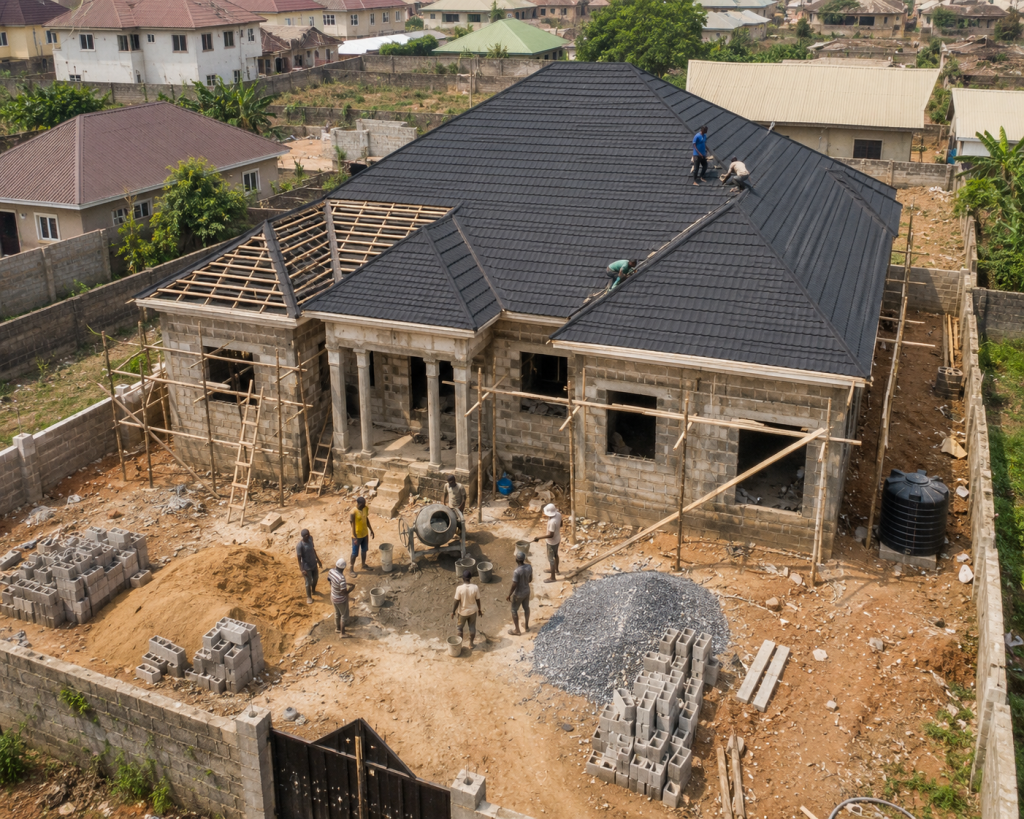
Building a house in Nigeria from abroad is completely doable in 2026, and thousands of diaspora Nigerians do it successfully every year. You just need the right plan, the right team, and the right approach to protecting your money at every stage.
This guide walks you through everything from budgeting and land acquisition to remote supervision, payment structures, and handover. Step by step. No theories. Pure practical and actionable steps.
Building a house in Nigeria from abroad requires 7 core steps:
Total construction timeline: 9 to 18 months depending on budget, location, and team quality.
The biggest mistake diaspora clients make is starting a project with a number they heard secondhand. A cousin built a 3-bedroom bungalow for ₦15 million two years ago, so you budget ₦15 million. Three months later, you are at ₦28 million with no roof and you keep wondering where the money went.
Material costs in Nigeria have risen sharply. Cement, steel, and labour all moved significantly between 2023 and 2025. Building a house in Nigeria from abroad in 2026 requires a current, verified budget, not what it cost someone else two years ago.
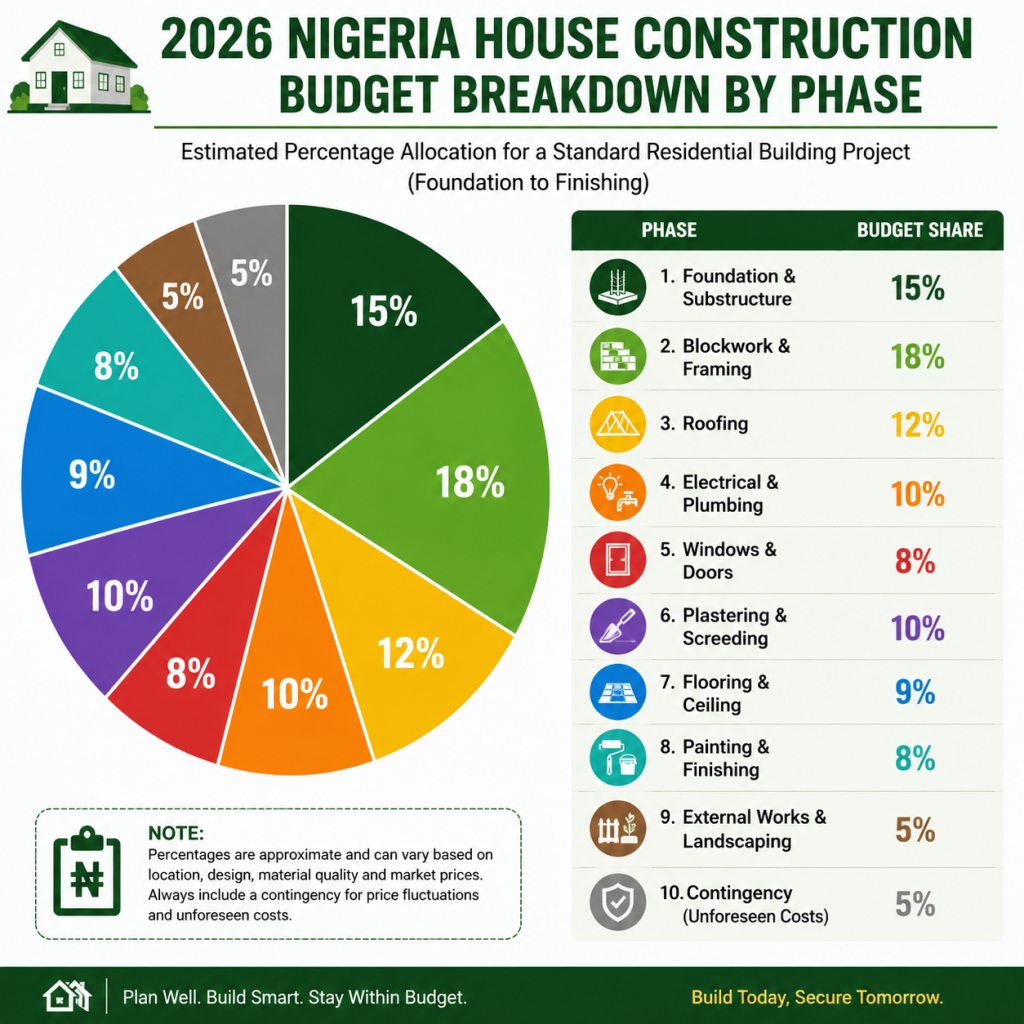
For a standard 3-bedroom bungalow of approximately 120–150sqm, here is a realistic 2026 cost breakdown:
| Construction Phase | Estimated Cost Range (2026) |
|---|---|
| Land acquisition (mid-tier location) | ₦3,000,000 – ₦8,000,000 |
| Foundation & substructure | ₦3,000,000 – ₦4,000,000 |
| Walling (blocks/interlocking bricks) | ₦2,200,000 – ₦3,500,000 |
| Roofing (aluminium or long-span) | ₦2,000,000 – ₦3,000,000 |
| Electrical & plumbing | ₦1,500,000 – ₦2,500,000 |
| Plastering, tiling & finishing | ₦5,000,000 – ₦7,000,000 |
| Windows, doors & fittings | ₦1,200,000 – ₦2,000,000 |
| Contingency (10–25%) — mandatory | ₦2,000,000 – ₦5,000,000 |
| TOTAL ESTIMATE | ₦20,000,000 – ₦35,000,000 |
Important note: These are 2026 estimates and vary significantly between states. Building in Lagos or Abuja is considerably more expensive than in Enugu, Owerri, Asaba, or Kaduna. Your Quantity Surveyor will produce a location-specific Bill of Quantities before work begins.
Related reading: Cost of Building a Bungalow vs Duplex in Nigeria (2026 Comparison) — see how the numbers shift when you go one storey up.
Land is where fortunes are made in Nigeria, and it’s also where plenty of diaspora Nigerians have lost millions of naira to wrong agents or real estate companies. Before you send any money home, do the following without exception.
If you are flexible on location, these areas offer strong value for diaspora builders right now:
When you are building a house in Nigeria from abroad, your project’s progress and success depend entirely on the team you put in place on the ground. You cannot be on-site. That means every key role must be filled by someone you have properly vetted not someone cousin recommended casually.
Pro Tip: Ask every contractor candidate to send a 60-second voice note or video introducing themselves and two past projects they are proud of. The way someone communicates tells you more about their professionalism than any CV or quoted price.
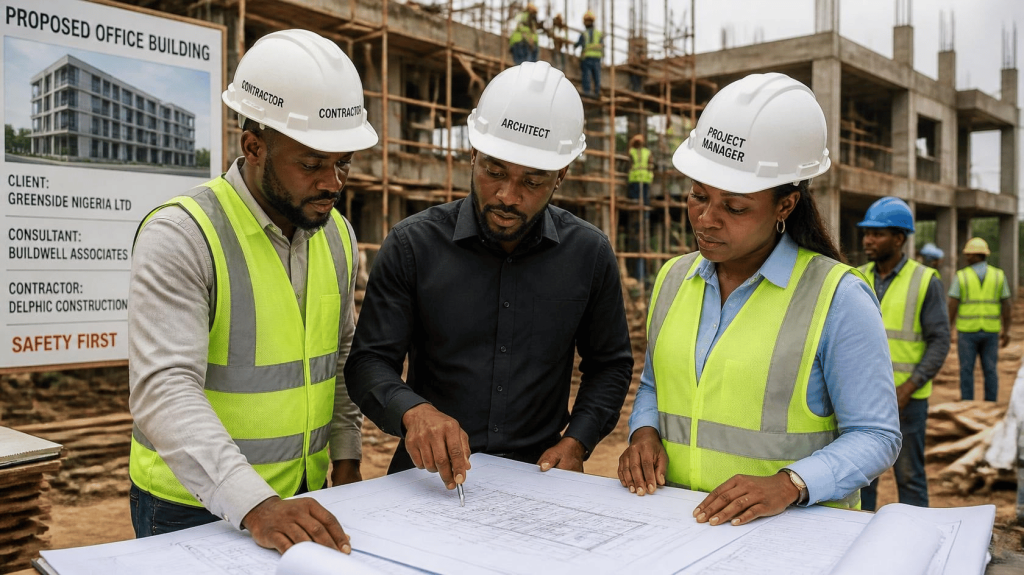
This step makes many diaspora builders nervous. It sounds bureaucratic, complicated, and like something that can be skipped. It cannot be skipped. Unapproved buildings in Nigeria are legally subject to demolition by state authorities, and no amount of investment protects you if your structure is not approved.
Building approval in Nigeria is handled at the state level:
The standard approach for diaspora builders: sign a notarized Power of Attorney from your country of residence authorizing your architect or PM to submit plans and handle approvals on your behalf. Your architect manages the entire process locally; you manage it remotely via email and WhatsApp.
Budget ₦300,000 to ₦600,000 for approval fees depending on your state and building size. Factor in a 3 to 6 month timeline and longer in some states. Start early. Approvals that are rushed cost more.
Read more: Lagos Building Plan Approval in 2026: What LASPPPA Needs, What It Costs, and How Long It Takes — a full breakdown of the Lagos permit process, required documents, and the e-permit portal.
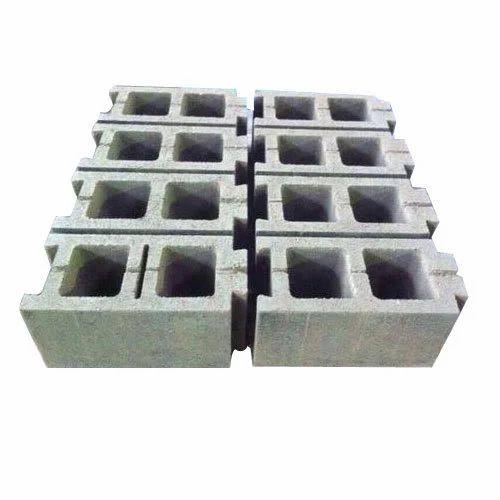
Material choices are where many Nigerian diaspora builds run into serious trouble. The temptation is always to import everything. Turkish doors, foreign cables, imported tiles and so on. Here is the honest truth: most of what is sold as “Turkish” furniture and doors in Nigeria is manufactured right here in Nigeria by companies operating under Turkish licenses. You can buy the same product at a fraction of the import price.
Similarly, Lagostar and several other locally produced cable brands perform at the same standard as imported alternatives. Nigerian-made interlocking bricks, laterite bricks, and aluminium roofing sheets offer excellent durability at significantly lower cost than imported counterparts.
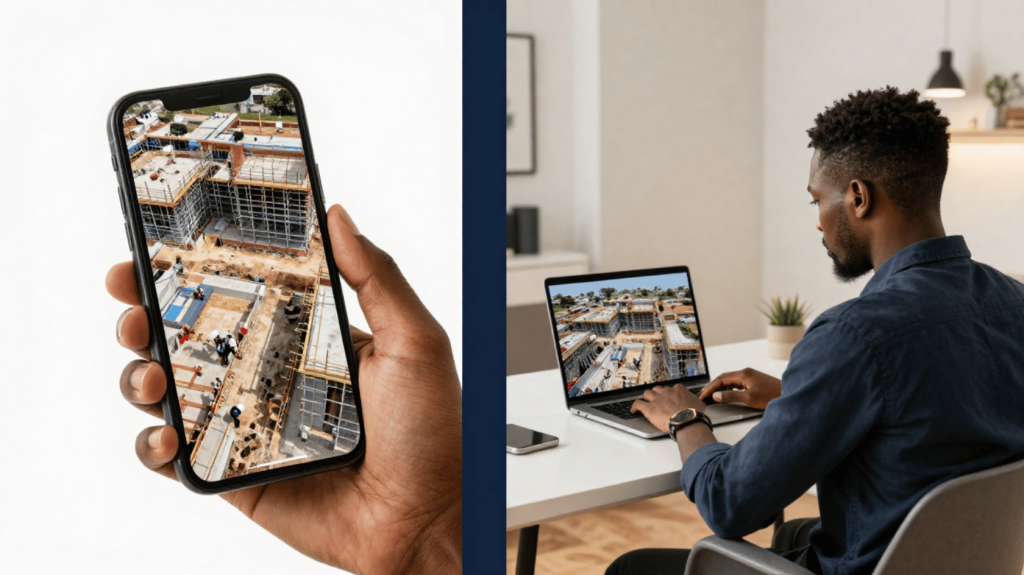
In 2026, building a house in Nigeria from abroad no longer means flying home every 2weeks. The tools available today give you near-daily visibility into exactly what is happening on your site at no significant cost.
Non-Negotiable Rule No photos. No payment. This rule applies to every team member, every phase, without exception. Make it part of your signed contract. Visual evidence is your only real-time verification when you are thousands of kilometres away.
Payment mismanagement is the number one reason diaspora builds go wrong. Here are the five rules that keep you in control:
Like the popular saying goes, “you don’t build a bridge in 3months”. You do not have to complete the entire house at once. In fact, phased construction is one of the most overlooked strategies for anyone building a house in Nigeria from abroad on a controlled budget.
The standard phased approach is to get the structure to roofing level first, then pause, then continue with internal finishing when funds are confirmed and available. This means you are never overextended; the structure is protected once roofed even during a pause, and you have time to vet finishing contractors more carefully.
There is another benefit that most people miss. Phased builds create natural inspection windows. If your foundation has a defect, the gap between phases gives your PM or supervisor time to identify and correct it before the next phase begins. That small window has saved entire projects.
Some of the most beautiful homes in Nigeria were built carefully over 3 to 4 years by people who never compromised their financial stability doing it. Think of it as a marathon, not a sprint.
| Phase | Estimated Duration | Key Tasks |
|---|---|---|
| Pre-construction (planning) | 2–4 months | Land purchase, legal checks, architect brief, drawings, approvals, team hiring |
| Foundation & substructure | 4–8 weeks | Site clearing, excavation, concrete to DPC level |
| Walling | 6–10 weeks | Block or brick laying from DPC to lintel and roofing level |
| Roofing | 3–5 weeks | Roof structure, covering, and weatherproofing |
| Electrical & plumbing | 4–6 weeks | Conduits, piping, ducting (coordinate with architect’s design) |
| Plastering & screeding | 4–6 weeks | Internal and external plaster, floor preparation and screeding |
| Finishing | 6–10 weeks | Doors, windows, tiles, paint, fittings — do not rush this stage |
| Inspection & handover | 2–4 weeks | Final checks, snagging list, defect resolution, formal handover |
| TOTAL | 9–18 months | Varies by budget, team quality, location, and season |
If you are building in Nigeria in 2026, integrate your solar setup during construction. Retrofitting it afterwards costs significantly more and requires rerouting cables that are already plastered into walls.
A basic 300W solar kit currently starts at around ₦500,000. A full home system covering your essentials like fans, lights, charging, and small appliances runs between ₦1,200,000 and ₦3,500,000 depending on inverter size and battery bank capacity. With NEPA supply as unreliable as it remains in Nigeria today, this is not optional for a liveable home.
Other sustainable features worth considering from the start includes rainwater harvesting tanks, a bio-digester system in place of a traditional soak away or septic tank, locally sourced timber for interior fittings, and thermal-insulating laterite bricks that reduce cooling costs passively.
Important Note on Architectural Design: Always ensure your building is designed by a registered architect. A properly designed plan is more than drawings and a 3D render; it is the complete blueprint for how your home functions. Badly designed plans lead to kitchens that open into bathrooms, long dark corridors with no natural light, and structural problems that cost a fortune to correct. Get it right before you lay a single block.
For a standard 3-bedroom bungalow (120–150sqm) budget between ₦35million and ₦50million in 2026, depending on location, materials, and finish quality. Lagos and Abuja are the most expensive. States like Enugu, Owerri, and Asaba are significantly cheaper. Always add a 10 to 25% contingency buffer to your base estimate.
The most effective combination is a trusted Project Manager on the ground, daily geotagged photo reports via WhatsApp, weekly Zoom or Google Meet site walkthroughs, and milestone-based payments. For critical phases like foundation and roofing, hire an independent site inspector to verify work before you release payment.
Allocate 18 to 22% of your total build budget to foundation and substructure. Never cut corners at this stage because a weak foundation is exponentially more expensive to fix than to build correctly the first time. Finishing (tiles, paint, fittings) typically takes 15 to 18% of the total budget.
Interlocking bricks, laterite bricks, locally produced aluminium roofing sheets, and bulk cement purchased directly from distributors (not open-market middlemen) offer the strongest value. Locally manufactured “Turkish-style” doors and furniture are produced right here in Nigeria by licensed companies and cost a fraction of direct imports.
Sign a notarized Power of Attorney from your country of residence authorizing your architect or Project Manager to submit building plans and handle approvals on your behalf. Your architect designs plans that comply with local regulations, submits to the relevant state authority (LASPPPA in Lagos, FCDA in Abuja, OCDA in Owerri), and manages the process. You stay involved via email and WhatsApp throughout.
Never pay more than 30% of a contractor’s fee upfront. Use milestone payments tied to photographic and video evidence of completed work. Sign a written contract before any work begins. Use escrow for large transactions. Interview at least three contractors and actually call their past client references. Don’t just read testimonials.
Ask for referrals from other diaspora builders who have completed projects. Check platforms like Jiji.ng, PropertyPro, and BuildServe Nigeria. Interview at least three candidates via video call. Ask specifically for references from remote-client projects and call those references directly. A good PM has experience working with clients who cannot visit the site regularly.
Building a house in Nigeria from abroad is not easy, and it is not as difficult as the stories make it sound. It is a logistics and distance challenge and one that thousands of diaspora Nigerians solve every single year with the right combination of planning, people, and technology.
Yes, there will be frustrating moments. Your contractor will go quiet for a weekend. Cement prices will move unexpectedly. A rainy season will delay your roofing by three weeks. That is Nigeria, and it is also the country where your foundation will be poured into red earth that your family will call home for decades.
Start with a solid, verified budget. Secure your land legally. Hire a team you have properly vetted. Monitor relentlessly using the tools available to you. Pay in milestones only. Keep a contingency fund ready. And build in phases if your cash flow requires it.
If you are a Nigerian in the diaspora planning to build back home, start while you are still in active service. Do not wait until retirement. The earlier you start, the more control and options you have. If you need guidance on any part of this process, reach out to the team at buildwitheasehq@gmail.com. We have helped diaspora builders navigate this process from start to handover, and we can help you too.
If this guide was useful, share it with another diaspora Nigerian who has been putting off building. It might be exactly what they needed to finally start.