Most Nigerian building projects fail because nobody is watching how money is being spent on site. Here's how weekly budget tracking changes that with 2026 figures, a free tracker template, and a system you can run from anywhere in the world.
Weekly budget tracking means recording every naira spent on your building construction site each week. It helps with construction budget control especially in Nigeria. This includes materials purchased, labour paid, equipment hired and then comparing that total against what you planned to spend at that stage.
The goal is to catch minor budget variations before they become expensive costs overruns.
Here are the 2026 baseline figures every builder in Nigeria should know before they start tracking:
| House Type | Cost Range (2026) | Lagos/Abuja Premium |
|---|---|---|
| 3-bedroom bungalow | ₦35M – ₦65M | Add 20–30% |
| 4-bedroom duplex | ₦75M – ₦150M | Add 20–30% |
| Contingency buffer | +15–20% of total | Non-negotiable |
Review every Friday. Compare planned vs. actual. Investigate any variance above 10% before the next week begins.
See the full breakdown: Cost of Building a Bungalow vs. Duplex in Nigeria (2026)
Here’s the uncomfortable truth: monthly reviews don’t work in Nigeria. If you’re waiting for 28 days before you review your building project budget in Nigeria, you might be doing yourself more harm than good.
Nigerian construction costs don’t wait for your monthly budget or team meeting. A 50kg bag of Dangote or BUA cement that was ₦12,500 in January 2026 can hit ₦15,000 by March. Iron rods, roofing sheets, PVC pipes, electrical cables all fluctuate with the dollar rate, diesel prices, and the general market pressure that comes with building in an import-heavy economy.
When you track monthly, you’re flying blind for 28 days at a time. That’s 28 days for a contractor to inflate purchase quantities, 28 days for petty cash to drain quietly, 28 days of price increases to accumulate undetected.
Weekly cost tracking when building in Nigeria gives you the warning sign ahead before it becomes a problem. It helps you on how to avoid running out of money while building. A ₦200,000 overrun caught in week one is a conversation. That same overrun unnoticed for eight weeks becomes a ₦1.6M problem.
The bottom line is this: building cost monitoring in Nigeria is not meant to scare you. It is the most basic discipline of successful construction project management.
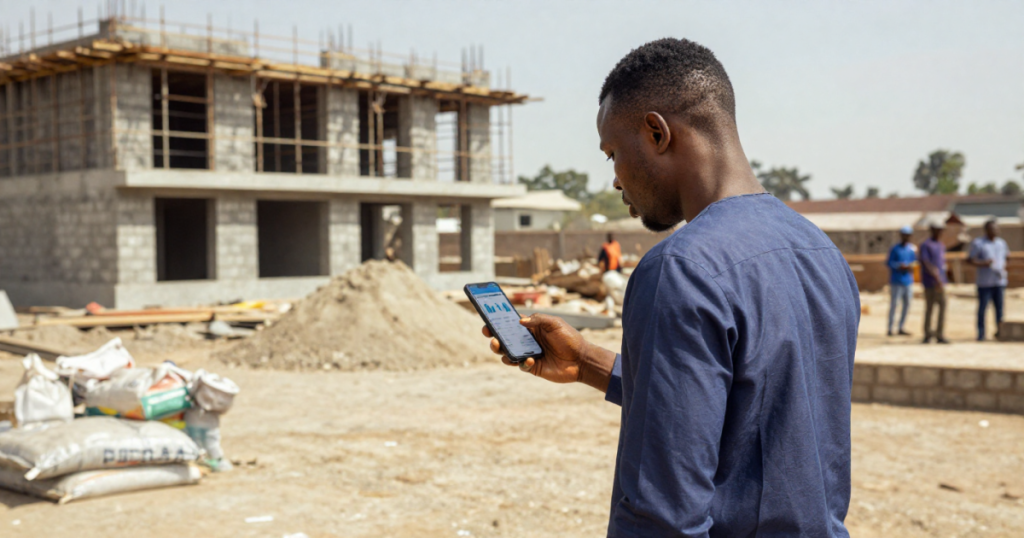
Before you can track weekly, you need to know what percentage of your total budget belongs to each stage. These allocations become your trigger points. When spending at one stage goes beyond its range, that’s your signal to stop and investigate before releasing any more funds.
| Construction Stage | Budget % | Approx. Cost (₦65M project) | Weekly Tracking Focus |
|---|---|---|---|
| Site Clearing & Foundation | 15–20% | ₦9.75M – ₦13M | Excavation, reinforcement, concrete, blinding |
| Structural Work (blocks, columns, beams) | 30–35% | ₦19.5M – ₦22.75M | Blocks, iron rods, cement, formwork, labour |
| Roofing | 10–15% | ₦6.5M – ₦9.75M | Roofing sheets, timber, nails, ridge cap, labour |
| Finishing (plumbing, electrical, tiling) | 30–40% | ₦19.5M – ₦26M | Flooring, painting, plumbing, electrical fittings |
| Contingency Buffer | 15–20% | ₦9.75M – ₦13M | Price spikes, surprises, design changes |
A few things to note:
Golden rule: Never release payment for the next stage until you have fully reconciled spending for the current stage. A 15-minute Friday review call with your contractor even by WhatsApp can save you millions.
This is the exact system we recommend to clients at Buildtracka, whether they’re on the ground in Lagos or managing their build from Houston or Manchester.
A BOQ is your tracking foundation. It is a master document produced by a registered quantity surveyor that lists every item in your project with estimated quantities and unit costs. Every bag of cement, metre of electrical conduit, square metre of tiling is duly calculated for.
Without a BOQ, you have no baseline to track against. Your contractor can tell you anything. With a BOQ, you verify every purchase against a pre-agreed scope and price.
QS fees in Nigeria: 1.5–3% of total project cost. On a ₦50M build, that’s ₦750,000 to ₦1.5M and it can be recovered through savings identified in the first few months.
Related: Quantity Surveyor Fees in Nigeria 2026 — What You Should Actually Pay
Break each stage budget into weeks. If your structural work budget is ₦20M and it’s expected to take 10 weeks, your weekly target is ₦2M. Some weeks may cost more, others less. It is a trigger point.
If week three of the structural stage has cost you ₦4M, that’s your cue to ask why before week four starts.
Every bag of cement, every payment to the bricklayer, every generator fuel purchase, every delivery must be recorded. No exceptions.
Small expenses are where money disappears quietly in Nigerian construction. “I bought nails” ten times a week across five trades adds up fast. If it’s not documented, it didn’t happen in your budget and you have no way to dispute it later.
This is one of the most underrated money-saving habits in construction materials cost tracking. Before releasing funds to buy cement, iron rods, roofing sheets, or tiles for any given week, call at least two to three suppliers and compare prices.
The difference between a good and a bad supplier quote in Nigeria can be 15–20% on the same item, in the same week. Always request delivery notes and receipts. These are your audit trail in any dispute with your contractor.
Friday is your reconciliation day. This is the heart of weekly budget tracking for house construction in Nigeria. Ask five questions every single week:
This planned vs. actual spending in construction Nigeria review takes 15–30 minutes. It is the most important meeting of your construction week.
Your contingency is not a second budget. It is emergency money. Keep it in a separate bank account and only release it when something genuinely unexpected occurs like sudden price spike, structural issue found during excavation, a legitimate design change.
Contractors will always find reasons to dip into contingency early. Your job is to resist that pressure until it is truly necessary. Spending contingency in week four of a 40-week project is how you end up with a stalled building.
A good weekly construction budget template Nigeria captures spending across these seven categories every week:
| Category | Examples | Why It Matters |
|---|---|---|
| Materials | Cement, blocks, iron rods, roofing sheets, tiles, paint, pipes | Largest cost centre; prices fluctuate weekly |
| Labour | Bricklayers, plumbers, electricians, carpenters, labourers | Often underquoted; rates rise in peak building season |
| Professional Fees | Architect, structural engineer, QS, site supervisor | Track milestone payments against agreed schedule |
| Equipment & Tools | Concrete mixer hire, scaffolding, generator fuel | Paid informally; easy to lose track of |
| Transport & Logistics | Material deliveries, site-to-site movement | Adds 5–8% to material costs if unplanned |
| Approvals & Levies | LASPPPA fees, council permits, inspection charges | Missing these can lead to site shutdown |
| Miscellaneous / Petty Cash | Security, site welfare, water supply, small purchases | Small individual sums that compound significantly |
Related: LASPPPA Building Permit Lagos: Full Requirements, Fees & Process (2026)
Here is a working weekly construction budget template Nigeria you can replicate in Google Sheets, Excel, or Notion. This example is from a foundation-stage week on a ₦50M 3-bedroom bungalow in Lagos:
| Week | Category | Description | Planned (₦) | Actual (₦) | Variance (₦) | Notes |
|---|---|---|---|---|---|---|
| Wk 1 | Materials | Cement — 100 bags × ₦12,000 | 1,200,000 | 1,250,000 | -50,000 | Price increase from supplier |
| Wk 1 | Materials | Iron rods — 2 tonnes × ₦620,000 | 1,240,000 | 1,240,000 | 0 | On budget |
| Wk 1 | Labour | Foundation labourers — 6 men × 5 days × ₦5,000 | 150,000 | 150,000 | 0 | On budget |
| Wk 1 | Equipment | Concrete mixer hire — 5 days | 50,000 | 50,000 | 0 | On budget |
| Wk 1 | Transport | Sand and gravel delivery — 3 trips | 90,000 | 105,000 | -15,000 | Extra trip needed |
| Wk 1 | Misc | Site security + water supply | 20,000 | 27,500 | -7,500 | Extra water delivery |
| Week 1 Total | 2,750,000 | 2,822,500 | -87,500 (3% over) | Cement price to watch |
That ₦87,500 overrun is a signal, not a catastrophe. Your response is to: (a) negotiate a bulk cement price for the following week, (b) update your stage budget projection to reflect the new market rate, and (c) check whether this pattern repeats in week two.
That is house construction cost management in practice. You don’t have to panic. Simply adjust early and you will catch the variation in week one, not week eight.
This is one of the most searched questions in building project budget Nigeria, and the answer in 2026 is more than you probably think.
| Contingency Level | When It’s Right |
|---|---|
| 10% | Locked-price contract + QS on site tracking every spend |
| 15% | Standard residential build with a full BOQ and professional supervision |
| 20% | Diaspora clients, self-managed builds, or projects using informal contractors |
| 25%+ | Complex design, difficult terrain, or periods of sharp naira/dollar volatility |
The rule Nigerians break most often: Never treat your contingency as part of the base budget. Once it’s gone, any genuine emergency maybe a foundation crack, a price spike, a roof problem, leaves you with no buffer and an incomplete building.
A building contingency fund Nigeria 10–20% is not pessimism. It is the difference between a completed home and an “uncompleted building” story.
The right tool is the one you’ll actually use consistently. Here are the best options for Nigerian builders in 2026:
| Tool | Best For | Cost |
|---|---|---|
| Google Sheets | Most self-managed builders. Syncs in real time, shareable with QS or site supervisor | Free |
| Microsoft Excel | Offline-first environments; powerful for custom formulas and stage budgeting | Free–₦15,000/yr |
| BuildOVE App | Nigerian-built; real-time budget tracking, task management, vendor tracking | Varies |
| Construction Cost Tracker (Android/iOS) | On-site logging, PDF export, estimated vs. actual comparison | Free–low cost |
| Monday.com / ClickUp | Teams managing multiple trades or subcontractors | ₦15,000–₦50,000/month |
| Quantity Surveyor + Formal Reports | Projects above ₦30M; BOQ-based monthly reconciliation | 1.5–3% of project |
| Buildtracka Project Supervision | Diaspora clients, busy professionals, high-value or complex builds | By scope |
Most Nigerian builders use a combination: personal weekly tracking on a spreadsheet + QS monthly reconciliation + professional site supervision for verification. The layers reinforce each other.
Yes; if your project is above ₦30M. Absolutely yes if you won’t be on site regularly.
The role of a Quantity surveyor in cost tracking in Nigeria goes beyond what any app can do. A registered QS:
Their fee is typically recovered in savings within the first few months. On a ₦60M project, paying ₦900,000–₦1.8M in QS fees to protect ₦60M of investment is straightforward arithmetic.
Related: How Much Architects Charge in Nigeria in 2026 (With Real Examples)
Cash flow planning for building project Nigeria is what sits behind weekly tracking. It answers the question your weekly tracker doesn’t: When exactly will I need the money?
Before groundbreaking, build a month-by-month cash flow calendar:
For diaspora clients sending money from the UK, US, Canada, or elsewhere: match your remittance schedule to this calendar. Don’t send lump sums without a stage-verified reason. Release funds in weekly or fortnightly batches tied to confirmed progress.
Running out of money mid-build is the most common and most preventable construction failure in Nigeria. Here’s the checklist that stops it:
Related: How to Build a House in Nigeria Step by Step: From Land to Keys (2026)
Diaspora building in Nigeria is one of the highest-risk project types not because overseas clients are less capable, but because physical absence removes the natural accountability that comes from being present on site.
You can’t verify if that the 400 bags of cement you paid for are actually on site. You’re dependent on contractor reports, a caretaker’s photos, and WhatsApp calls that may or may not reflect reality.
What cost tracking formats that actually works for diaspora clients managing construction projects in Nigeria from abroad:
Why is weekly budget tracking important for building a house in Nigeria? Material prices in Nigeria fluctuate weekly due to naira volatility and import costs. Weekly tracking allows you to verify contractor claims before releasing payments and is the most effective way to prevent running out of funds mid-build.
How often should I track my construction budget in Nigeria? Weekly, at minimum. For fast-moving stages like structural work or roofing, tracking twice a week is sensible. The best practice is a Friday review comparing planned vs. actual for the week just completed.
What expenses should I include in my weekly construction budget tracker? Materials, labour, professional fees, equipment hire, transport and logistics, regulatory approvals and levies, and miscellaneous petty cash with no exceptions.
What contingency percentage should I budget for construction in Nigeria? Budget 15–20% on top of your base construction estimate. In 2026, with naira pressure and material price volatility ongoing, 10% is the absolute minimum and only appropriate for tightly supervised, locked-price projects. For diaspora clients or self-managed builds, 20% is the safer choice.
How do I compare planned vs. actual spending on my building project? Use a weekly tracker table with columns for planned cost, actual cost, and variance. A positive variance means underspend; negative means overrun. Review every Friday, categorise by stage and expense type, and investigate any variance above 10% immediately. Don’t let it roll into the next week unexplained.
Should I hire a quantity surveyor for cost tracking in Nigeria? Yes, especially for projects above ₦30M. A Quantity surveyor produces the Bills of Quantities that becomes your tracking baseline, verifies contractor invoices independently, and issues formal monthly cost reports. Their fee 1.5–3% of project cost is typically recovered in savings within the first few months of construction.
How do I create a realistic building project budget in Nigeria? Start with a detailed BOQ from a qualified quantity surveyor. Allocate: foundation 15–20%, structure 30–35%, roofing 10–15%, finishing 30–40%, plus a 15–20% contingency buffer on top of everything. Secure at least 60% of your total budget before breaking ground and build a month-by-month cash flow calendar.
How can I avoid running out of money while building my house in Nigeria? Secure 60% of your full budget before starting. Use milestone-based contractor payments. Track spending weekly. Protect your contingency fund. Build a 4–6weeks cash buffer. Verify every invoice. And if you’re not on site regularly, hire an independent project manager or supervisor. This single decision prevents more project failures than any other.
How much does it cost to build a house in Nigeria in 2026? A standard 3-bedroom bungalow costs ₦35M–₦65M. A 4-bedroom duplex costs ₦75M–₦150M. Lagos and Abuja run 20–30% higher than other states. Add 15–20% contingency on top of whichever figure applies to your project.
Weekly budget tracking for house construction in Nigeria is not complicated. It is consistent. You record, compare and review every Friday. This way, you catch problems early and you stay in control.
The Nigerians who finish their buildings successfully on budget, without stalled projects, without contractor disputes that drag on for years are not necessarily the ones with the most money. They’re the ones watching their money weekly.
If you’re building in Nigeria and want professional eyes on your project every week whether you’re on the ground in Lagos or sending remittances from London Buildtracka provides on-ground project supervision, weekly spend reports, contractor verification, and client dashboards that keep you informed and in control at every stage.
Talk to a Buildtracka Project Manager via 08124857577
Also read: