
Here's the full 2026 breakdown of what to ask for, what it costs, and how to verify land documents before you make payment in 2026.
Land titles in Nigeria are the legal proof that a piece of land actually belongs to you and without one, you don’t legally own the land no matter how much you paid or how long you’ve farmed, fenced, or built on it.
A Certificate of Occupancy, Governor’s Consent, or a properly perfected Deed of Assignment is what stands between you and the same fate as thousands of Nigerians who’ve paid millions for land that turned out to be under government acquisition, sold to three different “owners,” or backed by nothing more than a receipt and a handshake.
In my years working in the built industry, I’ve seen this happen several and this guide breaks down every land title and legal document you’ll encounter in Nigeria in 2026, what each one actually protects you from, what the current fees look like in Lagos and Abuja, and the exact steps to verify a title before you commit your money. If you haven’t bought the land yet, read this alongside our full breakdown of the land acquisition process in Nigeria. Titles are the documents; acquisition is the process that gets you there.
Quick answer: At minimum, you need a registered Deed of Assignment, a Survey Plan, and evidence that the land carries a valid Certificate of Occupancy (C of O), Excision and Gazette, or has received Governor’s Consent. Without at least one of these underlying titles, a Deed of Assignment alone does not give you secure legal ownership, it only records that a sale took place.
This is the mistake that costs Nigerians the most money. A purchase receipt tells you that cash changed hands. It says nothing about whether the seller had the legal right to sell, whether the land is free of government acquisition, or whether five other people are holding receipts for the exact same plot.
Under the Land Use Act of 1978, all land in a state is technically held in trust by the Governor (or, in the Federal Capital Territory, the Minister). Every transfer of land, sale, mortgage, or long lease legally requires government consent to be valid. A land sale without that consent can be treated as if it never happened, regardless of how much was paid.
That’s the entire reason land titles in Nigeria exists. They are the paper trail that proves the government recognizes your right to that specific piece of land.
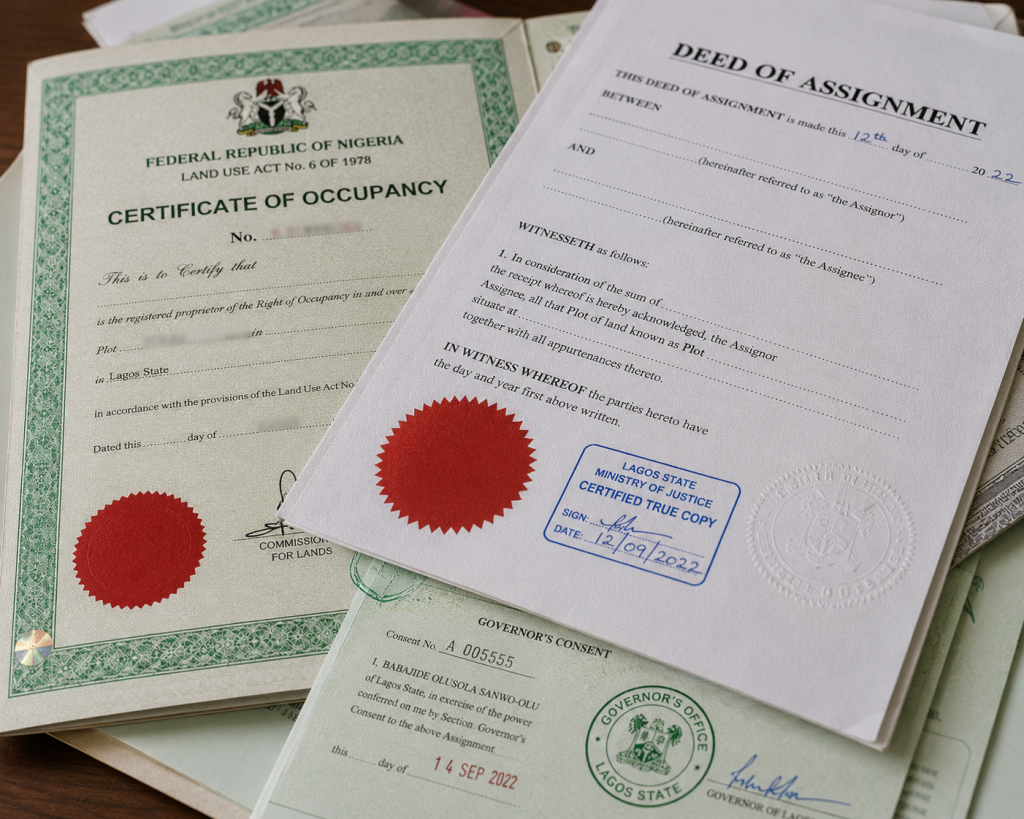
| Title Document | What It Proves | Issued By |
|---|---|---|
| Certificate of Occupancy (C of O) | Government-recognized right of occupancy for up to 99 years | State Land Registry / AGIS (FCT) |
| Governor’s Consent | Approval for a land transfer, mortgage, or lease | Office of the Governor / State Lands Bureau |
| Right of Occupancy (R of O) | Preliminary allocation, a step before a full C of O | State or FCT land authority |
| Excision | Government release of land from an acquired area back to a community | State Government |
| Gazette | Official publication confirming an excision or allocation | State/Federal Government Printer |
| Deed of Assignment | Records transfer of interest in land from seller to buyer | Prepared by lawyers, registered at Land Registry |
| Governor’s Consent-endorsed Deed | A Deed of Assignment that has been perfected with consent | State Lands Bureau |
| Power of Attorney | Authorizes someone to act on the owner’s behalf; weaker than a Deed | Notarized privately, sometimes registered |
A title document doesn’t work in isolation. A C of O without a registered Deed of Assignment, or a Deed without an underlying valid title, both leave gaps that a determined fraudster or an aggrieved second buyer can exploit.
Before you release any money for land in Nigeria, ask the seller for:
If a seller cannot produce most of these, that alone is a reason to slow down and verify. This is exactly the documentation stage covered in more depth in our guide to the land acquisition process in Nigeria, which walks through due diligence and title search step by step.
Governor’s Consent is the single most important document in a secondary land purchase, because Section 22 of the Land Use Act makes any transfer without it legally void. No Nigerian bank will accept land as loan collateral without it either.
The cost is calculated as a percentage of the government’s assessed value of the land not necessarily what you paid for it, and that assessed value has changed significantly in 2026.
Lagos State revised its official land valuation benchmark (the “Blue Book”) with effect from May 1, 2026, raising assessed land values in high-demand areas by as much as 300–525%. The percentage rates for Governor’s Consent, stamp duty, and registration did not change but because they’re calculated against much higher assessed values, the naira amount payable has jumped sharply in premium districts like Lekki Phase 1, Ikoyi, and Banana Island. In more typical mid-market areas such as Ajah, Gbagada, and Yaba, the increase is smaller in absolute terms but still noticeable.
As a rule of thumb for Lagos in 2026:
| Cost Component | Typical Range |
|---|---|
| Total buyer closing costs | 8% – 15% of purchase price |
| Government statutory fees (consent, stamp duty, registration) | 4% – 8% of assessed value |
| Legal and professional fees | 2% – 7% of purchase price |
In the Federal Capital Territory (Abuja), the structure is different. The flat fee to convert a Right of Occupancy into a full Certificate of Occupancy sits at roughly ₦3.5 million, alongside AGIS registration fees of around 8% of land value and an AGIS search fee of ₦10,000–₦20,000, plus professional and advisory fees. Recertifying an existing C of O required by AGIS to capture NIN and BVN details costs ₦50,000 for individuals and ₦100,000 for corporate bodies. Stamp duty on transfer instruments in the FCT is generally charged as a percentage of the assessed value, on top of any ground rent or development levy owed on the plot.
These figures move whenever government valuation benchmarks are revised, so always confirm current rates directly with the state land registry or AGIS before budgeting.
Large portions of land in Nigerian cities were originally acquired by government for public purposes. Where a community’s land falls inside such an acquisition, the government can later release (“excise”) a portion of it back to that community. The Gazette is the official government publication that records this excision.
If land you’re considering sits inside a government acquisition area with no excision or gazette backing it, you are exposed to the risk of demolition even if you’ve built a full house on it because the land was never legally released for private use. Checking for excision and gazette status is not optional due diligence; it’s one of the first things a competent land lawyer or surveyor should confirm.
If you can not follow the process through successfully, it is very much adviceable that you hire the services of a PM company like Buildtracka or a real estate service platform like propertypro to help you with your verification process.
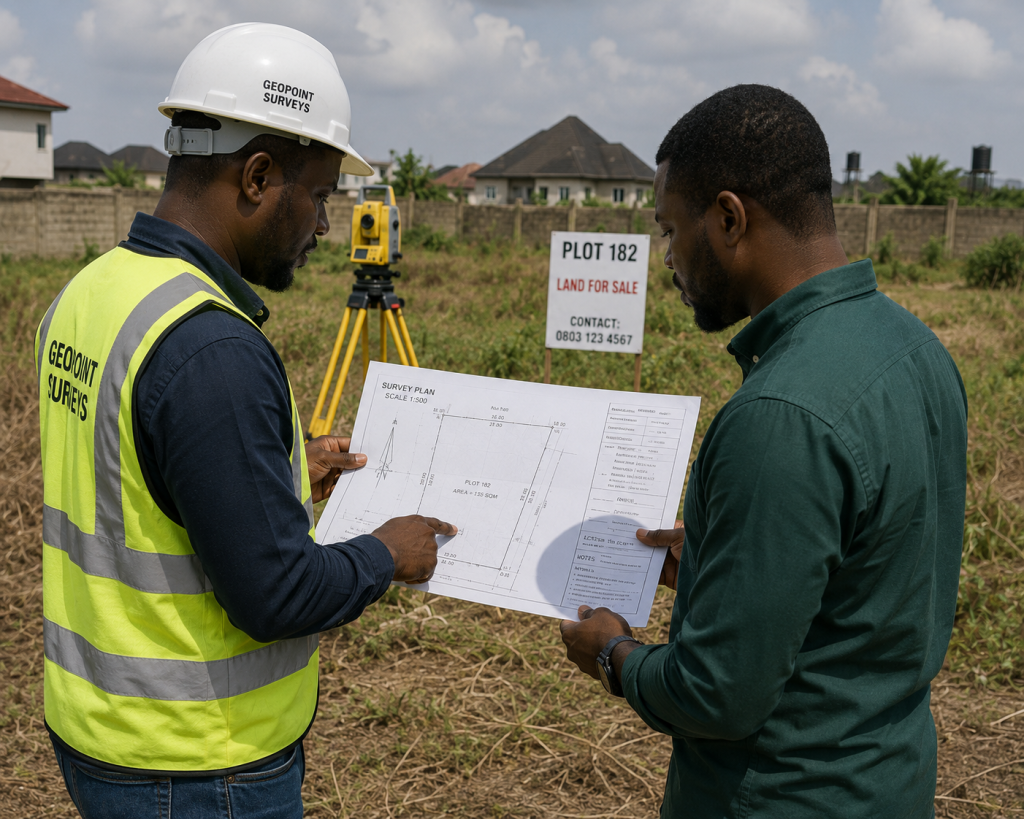
If you notice two or more of these, pause the transaction and get independent legal advice before proceeding. The same due-diligence discipline applies to hiring the people who’ll build on the land afterward.
See our guide on how to avoid contractor fraud in Nigeria for the construction-side equivalent of these red flags.
If you’re a diaspora Nigerian planning to buy land and build from the US, UK, Canada, or elsewhere, you’re relying entirely on people back home to verify documents, negotiate, and follow up at government offices, that’s exactly where fraud tends to concentrate. Land title verification in Nigeria still depends heavily on someone being physically present at the registry, which is difficult to manage from another time zone.
This is where independent project supervision earns its place. At Buildtracka, we handle land and document verification, site supervision, and construction project management for clients building in Nigeria including diaspora clients who need reliable eyes on the ground before and during their build. Our job is to protect your interests as the buyer, verify what you’re being told, and keep your project on track once you break ground.
What is a land title in Nigeria? A land title is the official document that proves your legal right to occupy, use, or own a piece of land.
What are the main types of land titles in Nigeria? The main titles are the Certificate of Occupancy (C of O), Governor’s Consent, Excision and Gazette, and Right of Occupancy (R of O), each issued at a different stage of land administration.
Is a Deed of Assignment enough to prove land ownership? No. A Deed of Assignment records that a sale took place, but it needs to be backed by a valid underlying title, C of O, Excision/Gazette, or Governor’s Consent.
What’s the difference between C of O and Governor’s Consent? A C of O is issued to the original grantee of a plot. When that land is later sold, the new buyer must obtain Governor’s Consent to make that specific transfer legally valid.
What is Excision and Gazette, and why does it matter? Excision is the government’s release of land from an acquisition back to a community, and the Gazette is the official record of that release. Together, they confirm the land is legally free for private development.
How do I check if land is under government acquisition? Visit the state Land Registry or the Surveyor-General’s office with the Survey Plan coordinates, and ask specifically whether the plot falls within a gazetted acquisition area.
Do I need a lawyer to handle land documents in Nigeria? Yes. A qualified real estate lawyer reviews every document, confirms the title is genuine, and manages the Governor’s Consent process, this is not something to handle informally to save costs.
If land documents aren’t registered, what will happen? Unregistered documents hold far less weight in a dispute. Registering your Deed of Assignment and obtaining Governor’s Consent significantly strengthens your legal position if the title is ever challenged.
The Power of Attorney, is it enough to buy land in Nigeria? Power of Attorney is used in some transactions but offers weaker protection than a Deed of Assignment. Where possible, upgrade to a full Deed of Assignment and pursue proper title documents.
How long does Governor’s Consent take to process in 2026? Processing time varies significantly by state and depends on how complete your documentation is.
How much does it cost to perfect land title in Lagos in 2026? Government statutory fees alone typically run 4% to 8% of the land’s assessed value following the 2026 valuation revision, with total closing costs (including legal fees) ranging from 8% to 15% of the purchase price.
Land titles in Nigeria reward patience and punish shortcuts, the same principle behind everything we cover on BuildWithEase. Buildtracka Integrated Services brings the Clarity, Control, and Cost Efficiency this process rarely comes with. Send an email to buildtracka@gmail.com to schedule a free consultation.
Read next:
Thinking about acquiring land or starting a build in Nigeria? Talk to Buildtracka about site supervision and due diligence support before you commit your money.