Most Nigerians budget for the building and forget the finishing, then the money finishes before the house does. Here's what finishing a house in Nigeria actually costs in 2026, broken down by house type, finish level, city and component, so you don't get caught halfway.
The building is standing, the walls are up, and the roof is on. From the road, it already looks like a house. Inside, you might think that you’ve done the hard part.
Then you get the finishing quote, and suddenly the house that was 70% done starts to feel like it’s only 30% done, money-wise.
That’s not your imagination. Finishing a house in Nigeria sometimes is usually more expensive than the structure itself and this is where most Nigerian building budgets quietly collapses. Tiling, POP, paint, doors, wardrobes, plumbing fittings and electrical work costs more than some people think.
In 2026, finishing a house in Nigeria costs between ₦70,000 and ₦320,000 per square metre, depending on whether you go basic, medium or luxury finish. For a standard 3-bedroom bungalow of about 130 square metres, that puts total finishing cost between ₦9 million and ₦40 million, excluding land, structure, fencing or a borehole.
| Finish Level | Cost per Square Metre (2026) | 3-Bedroom Bungalow (≈130 sqm) |
|---|---|---|
| Basic finishing | ₦70,000 – ₦100,000 | ₦9.1M – ₦13M |
| Medium finishing | ₦100,000 – ₦160,000 | ₦13M – ₦20.8M |
| Luxury finishing | ₦160,000 – ₦320,000+ | ₦20.8M – ₦41.6M+ |
Keep this table in your back pocket. We’ll break it down properly below, by house type, by city, and by individual item, so you know exactly where every naira is going.
Here’s something I tell every client at Buildtracka before we even open a drawing: structure is cheaper to estimate than finishing.
Blocks, cement and rods behave predictably. But finishing is where personal taste meets the market, and the market has a way of punishing indecision. You just want nice tiles, a simple POP design, and standard bathroom fittings, and somehow the quote comes back looking like you want to start building afresh.
The reason is simple: finishing is made up of dozens of small trades stacked on top of each other like tiling, painting, ceiling, doors, windows, kitchen, wardrobes, plumbing fittings, electrical fittings, and external works. Each one looks small on its own. Together, they routinely make up 35% to 45% of your total building cost.
So, if you’ve been budgeting for the house and treating finishing as an afterthought, this is your sign to stop.
Let’s get specific, because it depends, doesn’t help anyone standing in front of a tiler asking for a deposit.
| House Type | Approx. Size | Basic Finish | Medium Finish | Luxury Finish |
|---|---|---|---|---|
| 2-bedroom flat | 80–100 sqm | ₦6M – ₦10M | ₦10M – ₦16M | ₦16M – ₦32M |
| 3-bedroom flat/bungalow | 120–150 sqm | ₦9M – ₦15M | ₦15M – ₦24M | ₦24M – ₦48M |
| 4-bedroom bungalow | 180–220 sqm | ₦13M – ₦22M | ₦22M – ₦35M | ₦35M – ₦70M |
| 4-bedroom duplex | 250–300 sqm | ₦18M – ₦30M | ₦30M – ₦48M | ₦48M – ₦96M+ |
These figures are planning ranges, not fixed quotes. Your actual cost of finishing a house in Nigeria will shift based on your city, your material choices, and how tightly the project is supervised.
Note: A 4-bedroom duplex on luxury finish can cost more to finish than an entire 2-bedroom flat costs to build from scratch. For a deeper look at how these two house types compare across the entire build and not just finishing, check our guide on cost of building a bungalow vs duplex in Nigeria.
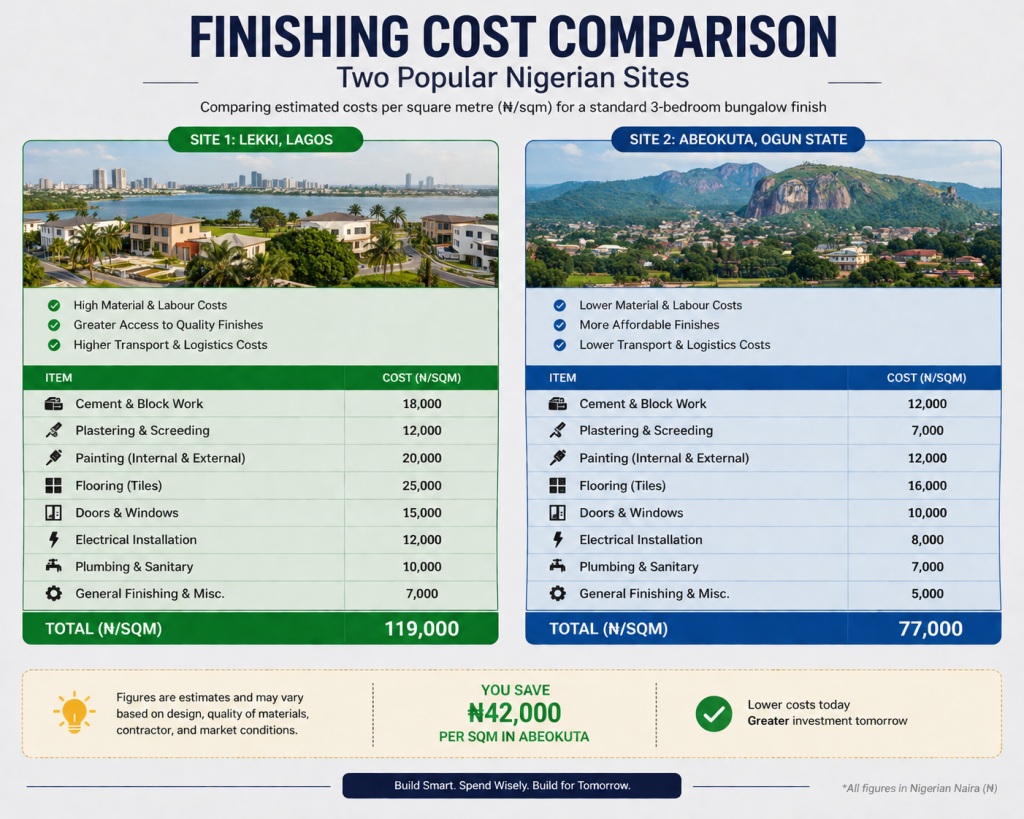
This is the section to bookmark. When your contractor hands you a bill of quantities, this table tells you whether you’re being quoted fairly or being quietly robbed.
| Finishing Item | Unit | 2026 Price Range |
|---|---|---|
| Floor tiling (materials + labour) | per sqm | ₦8,000 – ₦45,000+ |
| POP ceiling | per sqm | ₦5,500 – ₦25,000 |
| Painting (materials + labour) | per sqm | ₦4,000 – ₦11,000 |
| Doors (supply + fix) | per door | ₦35,000 – ₦250,000 |
| Aluminium/PVC windows | per sqm | ₦25,000 – ₦70,000 |
| Kitchen cabinets | per running metre | ₦60,000 – ₦180,000 |
| Bathroom fittings (per bathroom) | per unit | ₦150,000 – ₦1.2M |
| Wardrobes | per bedroom | ₦150,000 – ₦600,000 |
| Electrical finishing | per sqm | ₦4,000 – ₦9,000 |
| Plumbing finishing | per sqm | ₦3,500 – ₦8,000 |
A few honest notes here, because I’d rather you know now than after the fact:
If you want the item-by-item numbers on any single trade, we’ve written dedicated guides including our breakdown of labour cost for building a house in Nigeria, which shows where finishing labour typically lands inside your total budget.
Lagos and Abuja will always try to remind you they’re the capital of everything, including your budget. Location genuinely moves the needle here, mostly because of transport cost to site, artisan rates, and how many contractors are competing for your job.
| City | Finishing Cost Compared to National Average |
|---|---|
| Lagos | 20% – 35% above average |
| Abuja (FCT) | 15% – 30% above average |
| Port Harcourt | 10% – 20% above average |
| Ibadan | Around average |
| Enugu / Owerri | 5% – 15% below average |
| Kano | 15% – 25% below average |
If you’re a diaspora Nigerian building back home in Lagos or Abuja while quoting prices from a friend who built in Enugu three years ago, that’s your first mistake, and it’s a common one. Prices don’t just change with time. They change with postcode.
You don’t need a finance degree for this. You need three numbers and a bit of discipline.
So a 150 sqm bungalow on medium finish: 150 × ₦130,000 (midpoint) = ₦19.5M, plus 12% contingency = roughly ₦21.8M. That’s your working finishing budget, not your final bill, your working budget.
If you’d rather not do this math yourself, this is genuinely where a project manager earns their fee. At Buildtracka, this exact calculation, done properly with a bill of quantities, not guesswork is one of the first things we hand a client before a single tile is ordered.
You can spend less on finishing without turning your house into a shell of its former ambition. Here’s how:
I’ve supervised enough sites to know the mistakes repeat themselves, almost word for word, from Lagos to Owerri:
How much does it cost to finish a house in Nigeria? In 2026, finishing a house in Nigeria costs between ₦70,000 and ₦320,000 per square metre depending on finish level, translating to roughly ₦6M–₦96M+ depending on house size and quality of finish.
What is the cost of finishing a 3-bedroom flat in Nigeria? A 3-bedroom flat of about 120–150 sqm typically costs ₦9M to ₦24M to finish on a basic to medium finish, and up to ₦48M for a fully luxury finish.
What is the cost of finishing a 4-bedroom duplex in Nigeria? A 4-bedroom duplex of 250–300 sqm generally costs ₦18M to ₦48M to finish on basic to medium finish, and can exceed ₦96M for full luxury specification.
How do I calculate the cost of finishing a house in Nigeria? Multiply your total floor area (in sqm) by the per-sqm finishing rate for your chosen finish level, then add a 10–15% contingency for price fluctuations and unforeseen items.
How much does tiling, painting and POP ceiling cost in Nigeria? Tiling ranges from ₦8,000 to ₦45,000+ per sqm, POP ceiling from ₦5,500 to ₦25,000 per sqm, and painting from ₦4,000 to ₦11,000 per sqm, all inclusive of materials and labour.
What is the current cost of finishing a house in Lagos or Abuja? Lagos runs 20–35% above the national average and Abuja 15–30% above average, largely due to higher artisan rates and material transport costs.
How can I reduce the cost of finishing my house without compromising quality? Buy key materials directly, standardize tile sizes, negotiate labour separately from materials, plan the full finishing scope before starting, and get independent supervision to avoid costly rework.
How long does it take to finish a house in Nigeria? A standard 3-bedroom home typically takes 1 to 3 months to finish with consistent funding and supervision, though this can stretch well up to 6months or a year when finishing is done piecemeal.
The cost of finishing a house in Nigeria in 2026 isn’t a mystery, it’s a set of numbers most people simply never sat down to add up before starting. Now you have them.
Whether you’re building in Lagos from London, in Abuja from Lekki, or right there on your own plot in Owerri, the principle stays the same: know your numbers before your contractor tells you theirs.
If you’d rather not learn this the expensive way, that’s exactly the gap Buildtracka Integrated Services was built to close, independent project supervision and cost control for clients building in Nigeria, including remote clients building from the UK, US and Canada who need eyes on site they can trust.
Ready to finish your house without the guesswork? Reach out to Buildtracka at buildtracka@gmail.com for project supervision and cost monitoring, or read our related guides on architect fees in Nigeria, how to build a house in Nigeria step by step, and cost of building a bungalow vs duplex to plan the rest of your journey.
Related reading: