
Your ceiling has one job in Nigeria which is to survive the rainy season. Before you pick between POP, gypsum board and cement board, see what each one actually costs, how each one handles a roof leak, and which one Nigerian homeowners regret choosing.
If I am to ask you to choose between POP vs Gypsum Board vs Cement Board, which will you prefer and why?
I know most of you will choose the Plaster of Paris (POP) over others because everyone thinks it is more luxurious than the others, but that’s not the case.
Yes. POP gives you the most design flexibility and the classic finished Nigerian look, gypsum board is the faster and cheaper middle option, and cement board (fiber cement) is the most expensive upfront but the toughest against moisture, heat and termites long-term. Which one is best genuinely depends on your room, your roof, your budget, and how much patience you have for both installation and maintenance.
Which ceiling material is best for Nigerian homes?
For dry, well-roofed interior rooms like bedrooms and living rooms, POP remains the most popular choice for its design flexibility. Then for faster, budget-conscious jobs across large flat areas, gypsum board is the practical middle ground. For kitchens, bathrooms, coastal homes, and anywhere moisture is a real risk, cement board (fiber cement) is the safer long-term investment despite the higher upfront cost.
| Material | Cost per sqm (2026) | Moisture Resistance | Lifespan | Best For |
|---|---|---|---|---|
| POP (Plaster of Paris) | ₦5,500 – ₦25,000 | Poor, cracks and stains with leaks | 15 – 25 years (if roof is leak-free) | Living rooms, bedrooms, formal spaces wanting design detail |
| Gypsum board | ₦1,500 – ₦9,000 | Moderate, better than POP, still water-sensitive | 10 – 15 years | Bedrooms, offices, ceilings needing fast installation |
| Cement/fiber cement board | ₦15,000 – ₦17,500+ | Excellent, near-waterproof | 30 – 50 years | Kitchens, bathrooms, coastal homes, external soffits |
Now let’s go under the surface, because the sqm price alone doesn’t tell you the whole story.
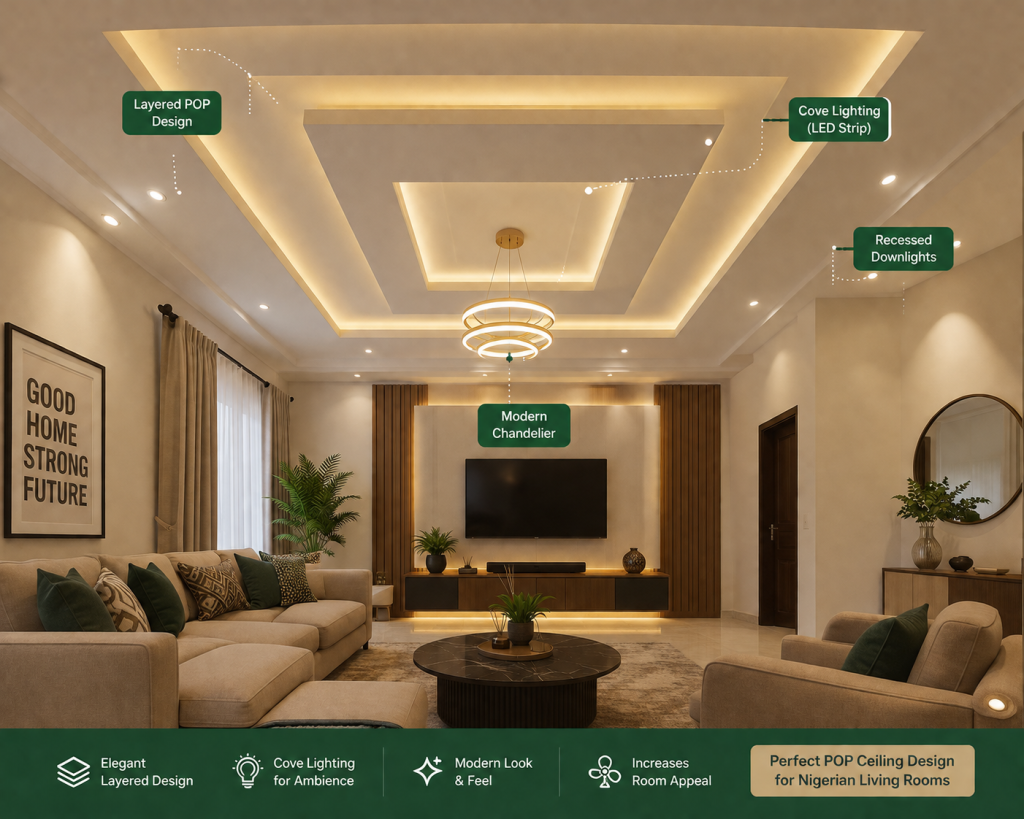
POP is what most Nigerians picture when they hear ceiling finishing. It’s a gypsum-based plaster, applied wet and moulded on site, which is exactly why it can do things the other two materials simply can’t like layered trays, cove lighting pockets, curved details, medallions, the works.
2026 POP cost per square metre:
| Design Complexity | Price per sqm |
|---|---|
| Simple/flat design | ₦5,500 – ₦8,000 |
| Moderately complex (2–3 levels, cove lighting) | ₦8,500 – ₦13,000 |
| Highly intricate (curves, medallions, layered) | ₦13,000 – ₦25,000+ |
For a standard 3-bedroom house, budget roughly ₦1.2 million to ₦2.5 million for full POP ceiling work, more if you’re going heavy on design in the living room.
Why Nigerians love POP: it looks premium, it’s fire-resistant, it conceals wiring and pipework beautifully, and a well-executed design genuinely adds resale value.
Where POP falls apart, literally: it hates water. A leaking roof, a burst pipe upstairs, even prolonged humidity, and POP stains, sags, or crumbles. Once damaged, it’s rarely a patch job, it’s usually a full redo, which is the single most expensive mistake we see on Nigerian sites.
Gypsum board comes pre-manufactured, think large, factory-finished panels installed on a metal or timber frame, rather than plastered wet on site. That single difference changes everything about the economics.
2026 gypsum board cost per square metre:
| Type | Price per sqm |
|---|---|
| Standard gypsum board | ₦4000 – ₦5,000 (material only) |
| Water/fire-resistant gypsum board | ₦6,000 – ₦8,000 |
| Fully installed (materials + labour) | ₦8,000 – ₦12,000 |
Gypsum board installs noticeably faster than POP because there’s no wet plaster to dry and no moulding to sculpt. For large, flat ceiling areas, think open-plan living areas or commercial spaces, that speed translates directly into lower labour cost.
Most modern Nigerian sitting rooms now use a hybrid approach: gypsum board for the flat central sections, with POP detailing applied at the perimeter. This gets you most of the POP look, at a noticeably lower total cost, with faster turnaround. Ask your contractor about this combination before committing to full POP everywhere.
The catch: gypsum board is more moisture-tolerant than POP, but it isn’t waterproof. In humid climates or rooms with plumbing directly overhead, it’s still a risk over the long haul.
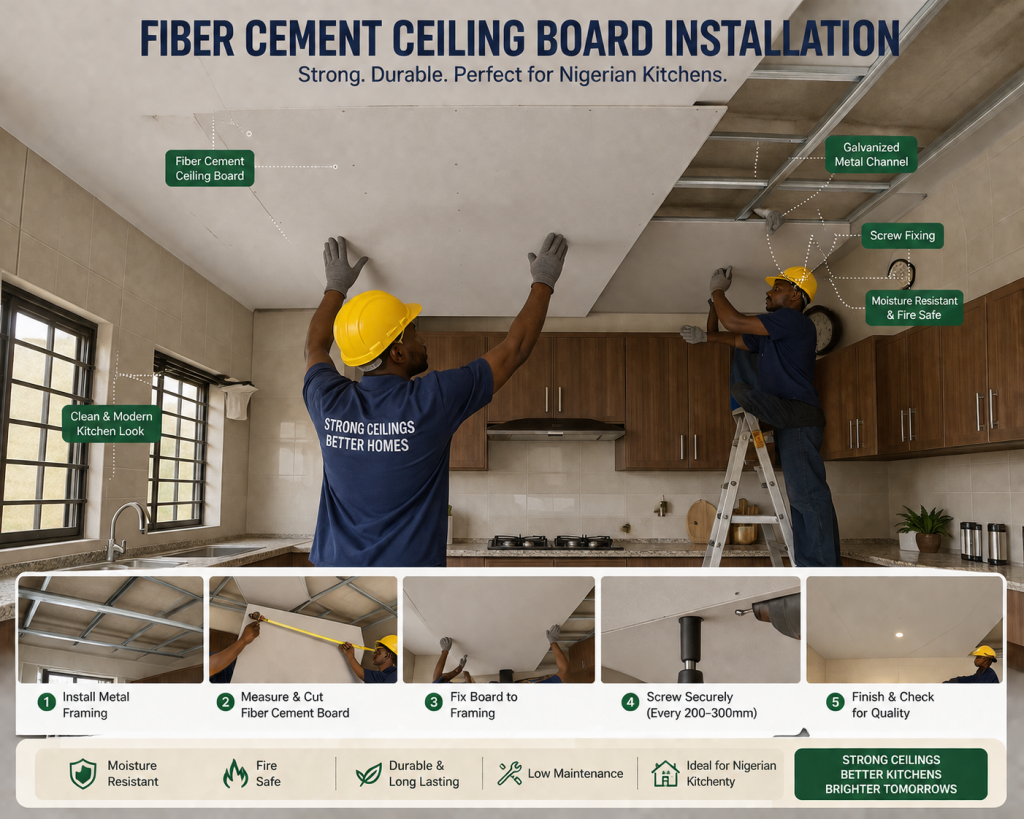
Fiber cement board is a composite of cement, sand and cellulose fibres, cured into a board that behaves almost like solid concrete but is light enough to install overhead. In Nigeria, the two names that dominate this category are Kalsi and Nigerite, both offering fibre-cement boards specifically engineered for ceiling, wall and cladding applications.
2026 cement/fiber cement board cost per square metre:
| Board Type | Price per sqm |
|---|---|
| Standard fiber cement board (4–6mm) | ₦4,000 – ₦9,000 |
| Premium branded board (Kalsi/Nigerite, 6–12mm) | ₦9,000 – ₦17,500+ |
| Fully installed, decorative grade | Up to ₦25,000+ depending on brand and finish |
Yes, it’s the most expensive material on this list by unit price. But run the actual numbers over time and the story changes. Fiber cement is non-combustible, rot-proof, and completely unbothered by termites, the exact insects that treat wooden ceiling battens like a buffet. Properly installed, it can last 30 to 50 years, which means you’re very likely never touching that ceiling again in your lifetime.
Here’s the comparison that matters: a POP ceiling damaged by a single roof leak often costs more to demolish and redo than the entire original fiber cement installation would have cost in the first place. That’s not a scare tactic, it’s simple total-cost-of-ownership arithmetic, and it’s exactly why we specify fiber cement for kitchens, bathrooms, and any coastal build in Lagos or Port Harcourt where humidity is a permanent tenant.
| Factor | POP | Gypsum Board | Cement Board |
|---|---|---|---|
| Cost per sqm (2026) | ₦5,500 – ₦25,000 | ₦4,000 – ₦12,000 | ₦8,000 – ₦17,500+ |
| Installation speed | Slower (wet application, drying time) | Fast | Moderate |
| Design flexibility | Excellent (curves, layers, medallions) | Moderate (flat panels, some trims) | Limited (mostly flat/functional) |
| Moisture resistance | Poor | Moderate | Excellent |
| Fire resistance | Good | Good | Excellent |
| Termite/pest resistance | Good | Good | Excellent |
| Lifespan (well-maintained) | 15–25 years | 10–15 years | 30–50 years |
| Repair after water damage | Usually full redo | Often full panel replacement | Rarely needed |
| Best rooms | Living room, bedrooms, foyer | Bedrooms, offices, budget projects | Kitchen, bathroom, coastal homes, soffits |
Stop thinking of this as one decision for the whole house. It shouldn’t be.
If your budget genuinely can’t stretch to full cement board everywhere, prioritise it in the two or three rooms where water is most likely to find you, and use gypsum board or POP in the drier, lower-risk rooms.
You don’t have to guess who supplies or installs these materials. A few names consistently come up as reliable sources across the market:
Whichever supplier or installer you go with, the brand or contractor name on the invoice matters far less than proper installation. Even the best fiber cement board will fail if it’s badly framed, and even basic POP will last if the roofing above it never leaks. This is precisely where independent site supervision earns its place catching bad framing, wrong screw spacing, or a leaking joint before it becomes a redo.
Which is better, POP or gypsum board? POP offers more design flexibility and a more premium finished look, while gypsum board installs faster and costs less per square metre. For flat ceiling areas without heavy design detail, gypsum board is the more practical and budget-friendly choice.
Is cement board better than POP for ceilings? For moisture resistance and lifespan, yes, cement board can last 30 to 50 years and resists water, fire and termites far better than POP. For decorative design flexibility, POP still wins, which is why many builders use cement board in wet areas and POP in dry, formal rooms.
How much does POP ceiling cost in Nigeria in 2026? POP ceiling costs range from ₦5,500 to ₦25,000 per square metre depending on design complexity, translating to roughly ₦1.2M–₦2.5M for a standard 3-bedroom house.
How much does gypsum board ceiling cost in Nigeria in 2026? Gypsum board ceilings cost between ₦1,500 and ₦9,000 per square metre fully installed, making it one of the more affordable ceiling finishing options available.
How much does cement board or fiber cement ceiling cost in Nigeria in 2026? Fiber cement board typically costs ₦4,000 to ₦14,800+ per square metre depending on brand and thickness, with premium branded boards like Kalsi sitting toward the higher end.
Is gypsum board waterproof? Standard gypsum board is not waterproof, though water/fire-resistant variants offer moderate protection. For rooms with real water exposure, cement board remains the more reliable option.
Can I mix POP and gypsum board in the same ceiling? Yes, this is a common and cost-effective approach in Nigeria. Gypsum board covers the flat central areas while POP detailing is applied around the perimeter, giving a premium look at a lower total cost.
How long does a fiber cement ceiling last in Nigeria? A properly installed fiber cement ceiling can last 30 to 50 years, significantly outlasting POP and standard gypsum board, especially in humid or coastal environments.
There’s no single best ceiling material for a Nigerian home rather, there’s a best material per room, matched to how much moisture that room will realistically see. POP for the rooms you want to impress guests in, gypsum board for the rooms where speed and budget matter more than design detail, and cement board for anywhere water is a genuine risk.
Get this decision wrong, and you’re not just repainting, you’re demolishing and starting over, usually at the worst possible time.
If you’d rather have someone on-site checking the roof, the framing and the installation quality before the ceiling goes up, not after the stains appear, that’s exactly the kind of supervision Buildtracka Integrated Services provides for clients building across Nigeria, including diaspora clients directing their project remotely from the UK, US and Canada.
Planning your finishing stage? Reach Buildtracka at buildtracka@gmail.com for independent project supervision, or read our related guides on the cost of finishing a house in Nigeria, cost of building a bungalow vs duplex, and architect fees in Nigeria to plan the rest of your build.
Related reading: